Argos, the software I use as a CRM and to monitor the applications I host, has one user: me. Since February 2026 it has exposed an MCP server, and on June 30 I removed its create and edit forms. I now drive it in plain sentences from Claude, and about a dozen agents in Hermès, my automation tool, go through the same server.
Tools instead of forms
The change came down to two pull requests on the same day. The first added tools that do in one call what used to take several screens. log_interaction records an activity, a note and the follow-up. get_context gathers everything about a company or a deal. daily_briefing returns the day’s priorities. Email triage takes two calls so that confirmation happens in the conversation: Claude shows the suggested attribution and only applies it once I agree.
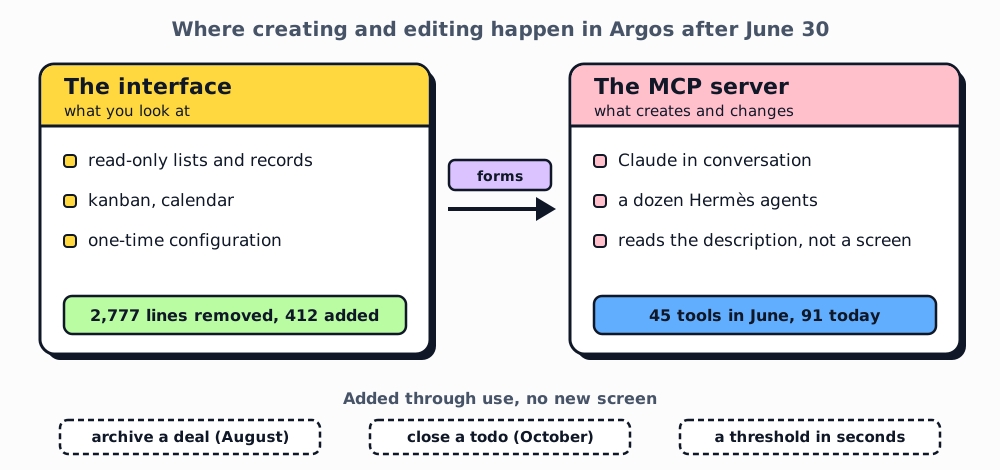
The second removed 2,777 lines and added 412. Projects, companies, contacts, deals, quotes and todos kept only their read screens and a few direct actions, such as moving a deal on the kanban board. The rule fit on one line of the pull request description: MCP does the work, the interface keeps what you look at (lists, kanban, calendar) and the configuration you only do once.
After a call with a client or a prospect, Granola pushes the conversation summary into Argos, and I don’t fill in a single field.
The same server for my agents
The agents have no separate API and no screen of their own. They call the same tools as Claude, with whatever role each tool requires:
- three agents read the list of monitored applications to track deployments, TLS certificates and response times;
mockup-builderclaims website mockup requests, generates them and hands back the result;llm-workerclaims Argos’s LLM calls and runs them on my machine, and Argos falls back to the API when a task fails;reach-notifierannounces every first prospecting email on Telegram, and Argos only sends it 24 hours later unless I object.
A tool added once works for Claude and the agents alike. In October, complete_todo was written so agents could close the todos they create: they have handled them on their own since, and I see them go by in my calendar.
The product grows through its tools
The server had 45 tools at the end of June and has 91 today, with no form coming back. When an action is missing, I add a tool with its tests instead of designing a screen. In August, archiving and deleting a deal created by mistake arrived that way, and the same pull request found where duplicate deals came from: prospect triage opened a second deal on a company already in the pipeline.
What it takes
A missing action no longer shows on screen; I find out when Claude says it can’t do it. And a tool’s description becomes the interface. On October 13, the description of create_deployed_application presented the alert threshold as a number of missed reports, while the code treats it as seconds everywhere: a model could write 3 and trigger an alert after three seconds. The form showed the unit and the default value; the model only sees the description. So I review those descriptions the way I review screens.