
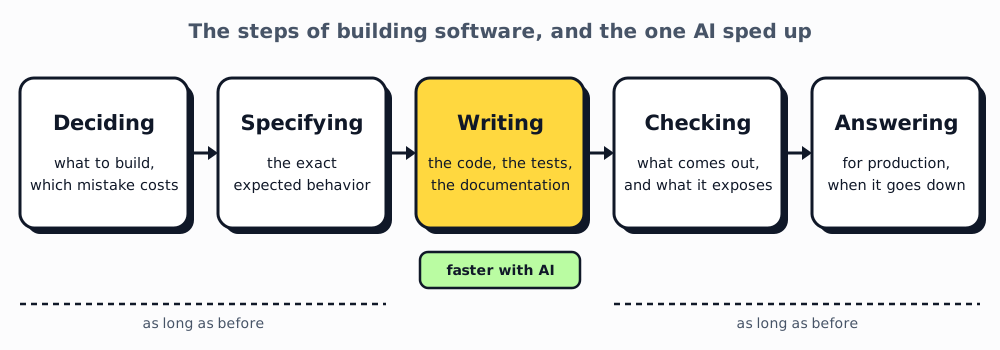
AI now writes a good share of my code, and my days are no shorter. What fills them changed: writing the code takes far less time, and everything around it moved in.
What got faster
The first draft of a screen, a migration, tests for a business rule that is already clear, a translation, API documentation, reading a repo nobody has opened in six months. On that work the gain is clear, sometimes threefold by rough estimate. But that is the visible part of the job, and the invoice fills up elsewhere.
Deciding
On my prospecting tool, a model scores companies on how likely they are to buy software from me. It gave almost everyone the same high score. Rewriting the prompt took one evening.
The rest took days: choosing which mistake costs me more, a good prospect I never see or a bad one that wastes an hour, then sorting dozens of companies by hand to have something to measure against. No assistant makes that call, because it does not know what costs you.
Specifying
On a management application, a demo company was shown “your subscription has been cancelled,” because the code did not tell “demo” from “stopped.” The change was one condition and one message, five minutes.
The half hour before went into what the code never asks. What should a demo company read? Who can change that status? What does an administrator see when impersonating a colleague’s account? AI writes the behavior you describe very well, not the one you need.
Checking
An assistant produces code that looks right, and that is what makes it misleading.
A pull request fixes one bug and cites two neighboring issues as debts it does not address, with a link to each. Any automation that closes “linked issues” closes both, and two live bugs vanish from the tracker.
A release of my e-invoicing gem passed its 317 tests and would not load for anyone who did not already have two of its dependencies. No tool pointed me to the missing check. It took knowing that the tests run in the repo while the user installs the package.
Securing
This summer in France, the leaks kept coming. The tax administration confirmed illegitimate access to its information system between June and August, using stolen credentials, and 678,000 people are reportedly affected according to the ministry. The national education ministry suffered an intrusion into its staff training platform that may have exposed data on staff who have worked in schools since 2001. SFR, a major telecom operator, warned fiber customers in August that their contact details had been read through an internal tool. Over 2025, the data protection authority received 6,167 data breach notifications, 9.5% more than in 2024.
Many of these leaks take no skill at all. In the spring, 11.7 million accounts at ANTS, the agency issuing ID documents, were exposed through a flaw attributed to an IDOR: changing a file number in the URL was enough to read someone else’s, because the server never checked who it belonged to.
That is exactly the kind of code that looks right. The screen works, the tests pass, and the hole only shows once someone exploits it. Reviewing every change while asking who could abuse it takes as long as it did before, and producing more code means more to review.
Answering for production
During a recent audit of an application, the code fixes took a fraction of the time they would have two years ago. What is left on my list is operations work you do not get to replay, done by hand by someone who answers for it. And when production goes down on a Saturday night, the model is not on call.
What it changes when you commission software
Ran Craycraft at thoughtbot frames the question well: having an AI build a prototype now costs almost nothing, so use it to check whether an idea deserves real investment. He adds that the dangerous moment comes when the prototype works and production seems within reach. A prototype exists to learn quickly. A production application has to protect data, control access and hold up when something fails.
Code was rarely the biggest line on a project’s bill, only the most visible one. When you pay a contractor, you are mostly paying for the decisions they make with you, what they check before shipping, security included, and the fact that they answer for what runs on your side. A quote promising a project “three times faster thanks to AI” assumes the project was nothing but writing code: ask what happens to the decisions, the checks, security and production.
Senko Rašić points out that saying “code was never the hard part” dismisses a whole profession. Writing code still takes skill. Its cost went down, the cost of the rest did not.
If you are weighing a prototype against a real project, we can look at your context together.
To see how I bring AI into my clients’ software, read the page about AI integration. If you are not sure where to start, there is also the AI audit and training for your teams.